Procedures

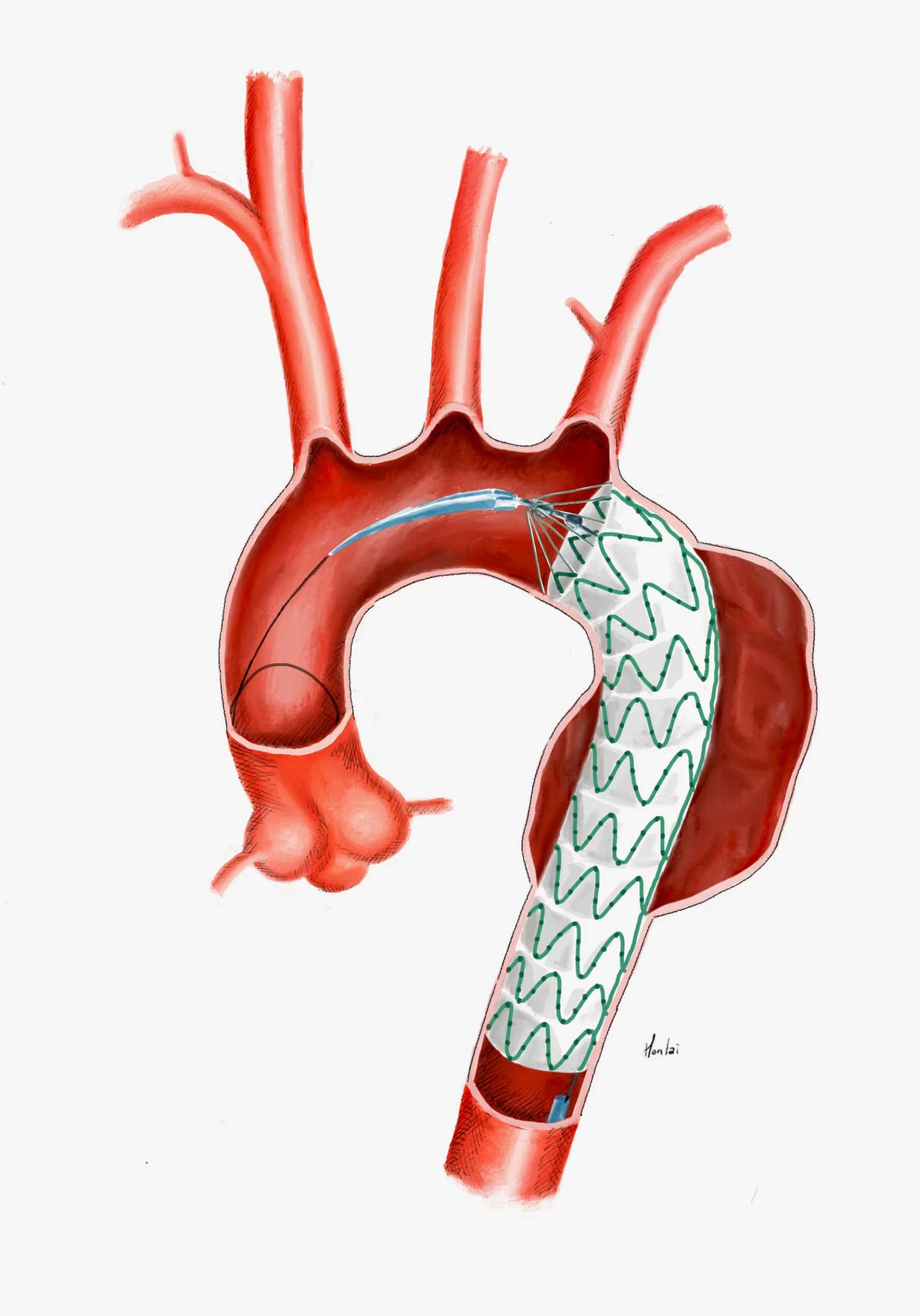
Thoracic Aortic Aneurysm: Thoracic endovascular aortic repair

A thoracic aneurysm withat least 20mm of non-aneurysmal aorta between the left subclavian artery and the aneurysm AND at least 20mm of non-aneurysmal aorta between the aneurysm and the celiac trunk can usually be treated endovascularly using a standard off-the-shelf stent graft system. However, some additional anatomical conditions must be met for a successful TEVAR. These include but are not limited to a cylindrical (as opposed to conical) neck; a neck diameter between 20and 42 mm; limited amount of thrombus and calcification in the necks; iliac arteries that allow the introduction of the delivery systems.

Learning targets

  • Implantation of a thoracic stentgraft in the proximal descending aorta/distal aortic arch
  • To properly handle access tools
  • To correctly position graft in proximal landing zone to avoid parallax error
  • To avoid or reduce endovascular manipulation in the aortic arch
  • To use blood pressure lowering options for stentgraft deployment
All Steps in Detail

Step1: Gaining access to the groin vessels

  1. Scan the entire length of the common femoral arteries by ultrasound to determine the ideal puncture site. It should ideally be located at the level of the femur head while avoiding areas of ventral calcifications, intraluminal thrombus or stenoses. If these prerequisites cannot be met, an open access to the groin vessels should be considered.
  2. Retrograde puncture of both femoral arteries under ultrasound guidance. This means defining the exact entry point of the needle into the artery on ultrasound and then not moving the ultrasound probe. With your other hand, guide the needle in a 45° angle until you identify the tip at your point of entry. When pulsatile flow is exiting the needle, advance the J-tipped steel wire carefully and without resistance. If in doubt, advance under fluoroscopy.
  3. Oblique skin incision around the needle, ca. 1cm long, on the side where you intend to introduce your grafts. Then divide the subcutaneous tissue and the subcutaneous fascia using a mosquito clamp and predilate the vessel wall using an 8F dilator.
  4. Apply a pre-close closing system if using, usually two devices are required.
  5. Introduce a short 8F sheath on the side where you intend to introduce your stentgrafts and a 6F sheath on the other side.

Step 2: Perform your procedure

  1. Bring up soft guidewire (e.g. Terumo) under fluoroscopic guidance to ascending thoracic aorta on the side where you intend to introduce your stentgrafts.
  2. Change to a double curved Lunderquist wire via a pigtail catheter.
  3. Remove 8F sheath and exchange with large bore sheath if using. Alternatively, if using a sheathless system, bring up your stentgraft.
  4. From the other side, bring up a soft wire and then a pigtail catheter into the distal ascending aorta.
  5. Perform an angiogram of the arch in the correct angulation (usually between 45° and 80°LAO)
  6. Depending on your landing zone and how exactly you need to position your graft, consider reducing cardiac output during deployment of the graft, e.g. by rapid right ventricular pacing or balloon inflow occulusion.
  7. Deploy your stentgraft as planned.
  8. Extend distally if needed.
  9. Balloon entire system using a compliant balloon if using. NOTE: NEVER balloon in dissection cases.
  10. Perform final angiogram.

Step 3:Close your femoral accesses

  1. Remove catheters and sheaths and close accesses using your predeployed closure devices or use other closure devices with an intravascular anchor.
  2. If this does not stop bleeding adequately, consider using additional closure devices with an intravascular anchor.
  3. If bleeding still persists, consider compression bandaging or, if bleeding is too strong, perform cutdown and close puncture site as appropriate.

Control of educational objects (tutors and trainees)

Pictures and Drawings

No items found.

Courses Teaching this Procedure

No items found.

Simulators Used for this Procedure

No items found.

About Vascular International

The Vascular International (VI) School for Vascular Surgery is dedicated to advancing the training and education of vascular surgical techniques through the use of lifelike models. With patient safety as the top priority, VI continuously strives to enhance vascular surgery training, ensuring the highest standards of safe and effective open and endovascular patient care.

About Us